
Will Crypto Go Back Up?
Updated August 2026 · Educational market context, not financial advice
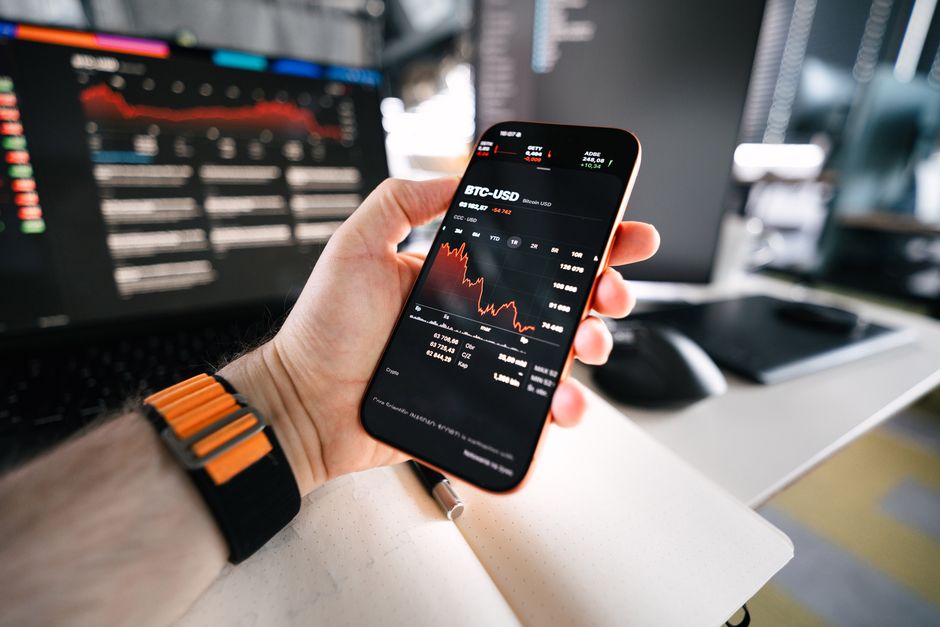
Nobody can promise you a recovery — but history is surprisingly consistent on this one: the crypto market as a whole has come back from every major crash so far. The catch is that "crypto" isn't one thing (plenty of individual coins never recovered), past patterns don't guarantee future results, and recoveries have never once announced themselves. They start in the quietest, most boring stretch of the cycle — usually while everyone is still staring at the crash.
If you're typing this question into a search bar, we can probably guess the scene. You're down. You check the price the way you'd poke a bruise — not because you expect it to feel better, but just to confirm it still hurts. The group chat that used to post rocket emojis has quietly rebranded into a fantasy football league. And your cousin, the one who wouldn't shut up about his portfolio at Thanksgiving, has developed a sudden and suspicious passion for pickleball.
So let's take the question seriously, because it deserves better than the two answers you'll find on your feed — "it's over forever" and "100x incoming, trust me." Quick honesty up front: nothing here is financial advice — it's educational context for your own research.
What history actually says about crypto recoveries
Start with the verifiable part. Bitcoin — the asset that effectively is the market's heartbeat — has been declared dead by headlines hundreds of times, and has so far recovered from every major drawdown in its history: the 2011 crash, the 2014–15 winter, the 2018 collapse, the 2020 pandemic flush, the 2022 bear. Each one felt terminal in real time. Each one, in hindsight, was a chapter of the same repeating market cycle — crash, bottom, boring stretch, recovery, mania, and around again.
And here's the part worth staring at, because it's all sitting on the chart for anyone to check. In December 2018, Bitcoin printed a weekly low of $3,120. At the time it read like confirmation the whole experiment was over. Six months later the weekly close was around $10,761 — and the cycle that followed peaked near $69,000 in November 2021. In November 2022 the low was $15,470, a drop that happened inside what the remi chart labels an Accumulation phase, with the label never changing — and the cycle that grew out of it peaked near $126,000. Pull up the chart today and try to find those drops. They're wiggles. Measured against where each cycle actually went, the moves that dominated every headline barely register. That's not a promise about any future cycle. It's the recorded history — dated, public, and exactly the kind of thing worth knowing before your feed tells you what to feel about a red week.
That's the honest bull case for "yes, it has always come back so far." Now the honest fine print, because there are two pieces of it and both matter:
- "The market" recovered. Not every coin did. Bitcoin reclaiming highs is a historical pattern. Thousands of altcoins from previous cycles never saw their old prices again — the market moved on without them. "Will crypto go back up?" and "will my coin go back up?" are different questions, and the second one has a much less comforting history.
- Past recoveries don't guarantee the next one. Every cycle so far has turned. Nothing in markets is owed to anyone. Anyone who tells you recovery is certain is selling certainty they don't have.
Why is crypto down in the first place?
Understanding the "why" matters less than people think — because the honest answer is usually the same boring one: markets move in cycles of expansion and contraction, and crypto runs those cycles with the volume turned all the way up. Liquidity tightens, leverage unwinds, sentiment flips, and the same crowd that paid any price in the euphoria won't touch it at a discount in the fear. If you want the full anatomy of a crash — what actually drives them and what history shows about how they've resolved — we wrote it up in why is crypto crashing?
The important part for this question: a crash is a phase, not a verdict. In remi's six-phase view of the cycle, the crash is the Bear Market phase — and what comes after it, historically, isn't the recovery. It's something much quieter.
Recoveries start boring — that's the part nobody tells you
Here's the pattern that trips almost everyone: historically, recoveries didn't begin with a headline. They began with silence. After the crash exhausts itself (which is its own phase change), markets have tended to grind sideways through a long, dull stretch — the Bottoming and Accumulation phases — where price goes nowhere, nobody posts about crypto, and the whole asset class quietly falls out of the conversation. The crypto cycle is just four seasons, except winter lasts ages and everyone forgets it's coming every single time.
By the time "crypto is back" reaches your feed, the move is usually well underway — the loud part of a recovery is the middle of it, not the start. That's not a conspiracy; it's just how attention works. Everything that ends up loud starts out silent. And historically, the market didn't feel safe again until the move was well underway — the mood and the structure have rarely turned at the same time.
How long does crypto take to recover?
People want a number here, and anyone who gives you a confident one is decorating a guess. What the record shows: past downturn-to-recovery stretches have ranged from months to multiple years, with long flat periods in between that tested people far more than the crash did. The 2014–15 and 2018–19 winters each ran on the order of a year-plus before sustained recoveries took hold; the 2020 crash reversed in months. The spread is the lesson — the cycle has rhythm, but it doesn't keep a calendar. Some analysts anchor the rhythm to Bitcoin's roughly four-year halving schedule; others argue ETFs and institutional flows have stretched or broken that clock entirely. Historically, the turn has only ever been obvious in hindsight.
The more useful reframe: stop asking "when" (unknowable) and start asking "where are we now?" (researchable). You can't time the exact bottom — no widely-followed method has reliably done it — but you can get an educated read on which chapter of the cycle the market is currently in. That's a question an educational framework can genuinely help you research, even though it can't decide anything for you.
The expensive mistake people make while waiting
Here's the pattern that does the real damage, and if it stings, know that it's basically a rite of passage. Across past cycles, the same round trip repeats: people bought during the loud part, held through the crash, and finally sold somewhere near the quiet bottom — and then watched the market recover without them. The full round trip. Maximum pain at both ends. (To be clear: that's a description of crowd behavior, not a playbook — what's right for any individual is theirs to decide.)
The brutal detail is that the coin was often fine. In plenty of past cases the market came back and, eventually, so did the asset (though many others never did — see below). What didn't recover was the position of the person who bought in the wrong season and sold in an even worse one. Markets aren't usually lost on bad analysis — they're lost on emotion. At the top, the feeling screams "you're missing it," and at the bottom it whispers "it's over, make the pain stop." Both feelings arrive with impeccable confidence and zero data. The cycle is really a map of that crowd psychology — fear, greed, capitulation, euphoria — and most people get wrecked because nobody ever told them which chapter they were in.
This is exactly why the remi Cycle Index exists
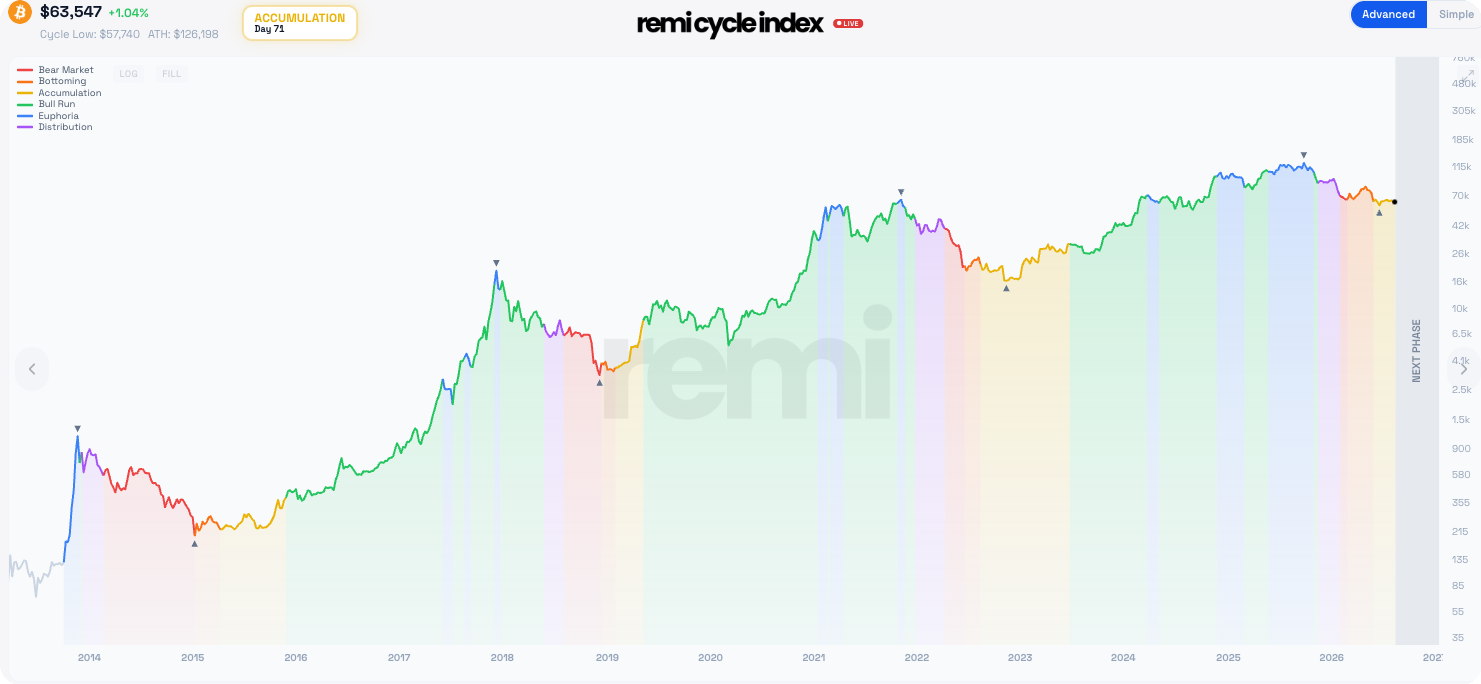
You can't fix the feelings. They're factory-installed. What you can do is stop making them the only instrument on the dashboard. The remi Crypto Cycle Index is a super indicator — it melts a range of market indicators into one readable, educational view of the cycle, across six labeled phases: Bear Market, Bottoming, Accumulation, Bull Run, Euphoria, and Distribution. Instead of juggling a dozen charts and your own rattled nerves, you get one plain-language, educational estimate of which chapter the market is in.
It's live and updates daily, so the read progresses as the cycle does — rather than sitting frozen on the day someone published a chart. Positive readings may reflect stronger market conditions; negative readings may reflect weaker or risk-off conditions. It won't tell you to buy, sell, or wait — the umbrella decision is yours. It just replaces "how do I feel right now?" with "where are we actually in the cycle?" — which, at a bottom, are two very different answers.
See which phase the market is in
remi melts a range of market indicators into one educational read on the cycle, across six phase labels. No hype, no price targets. Set up a free account and remi can email you when the cycle phase changes — so you can stop checking the chart like it's a bruise.
View the Crypto Cycle Index →Educational only. Not a trading signal or a recommendation to buy, sell, or hold. Crypto is highly volatile — phase updates don't reduce the risk of loss.
What a real recovery has historically looked like
Not a prediction — a pattern library. Looking across previous cycles, sustained recoveries have tended to share a structure, and it's close to the mirror image of a market topping out:
- The lower lows stop. First, price simply stops making new lows — even while the news stays ugly. The crash's engine quietly cuts out.
- Higher lows start. The floor holds, then rises. Structurally, this is the single most important shift — and it happens while nobody's watching.
- Boredom does its work. A long, flat, unglamorous stretch where patient capital accumulates and everyone else finds pickleball. Historically, this is where recoveries were built — not where they were felt.
- The loud part comes last. By the time recovery is a headline, a trending topic, and your cousin's favorite subject again, the quiet phases are long over.
Note what's not on that list: a date, a price target, or a guarantee. History offers structure, not promises — and no two cycles have matched exactly. For the follow-on question of what ignites the loud part, see when is the next bull run?
Common questions
Will crypto go back up?
No one can say with certainty. What's verifiable: the crypto market as a whole has recovered from every major crash in its history so far, while many individual coins have not. Past patterns don't guarantee future results. For a live, educational read on which cycle phase the market is in today, see the remi Cycle Index.
Will crypto recover from this crash specifically?
This exact question — with "this crash" attached to a different crash — has been asked at every downturn in crypto's history. So far the market has recovered each time, and each time it felt like it wouldn't. That's context, not a promise: no recovery is guaranteed for any asset or timeframe.
How long until crypto recovers?
Historically, anywhere from months to years — the spread is too wide for anyone to name a date honestly. The turn has only ever been clear in hindsight, which is why watching the market's structure (the phase) has historically been more useful than watching the calendar.
Do all coins recover when the market does?
No — this is the least-told truth in crypto. In previous cycles, the market recovered while thousands of individual altcoins never reclaimed their old highs. Market recovery and individual-asset recovery are different things with very different track records.
Is a crypto bull run coming?
If history's pattern holds, another one is possible — but not promised, not confirmable in advance, and not on anyone's schedule. What can be observed is the sequence: bull runs have historically emerged from long accumulation phases, not from crashes directly. We cover the anatomy in when is the next bull run?
Not financial advice
remi is an educational market-intelligence tool. Nothing on this page is investment, financial, legal, or tax advice, and nothing here is a recommendation to buy, sell, or hold any asset. Use remi as educational market context, not as personalized financial advice. Cryptocurrency is highly volatile and carries significant risk, including the risk of total loss — always do your own research and consider speaking with a licensed professional before making any decision.
Photo by Jakub Zerdzicki on Pexels.
Last updated: August 2026 · Cycle Index · Privacy · Terms